

 English
 中文简体
中文简体 Español
The Fastest Way to Know If a Car Relay Has Failed
A blown relay in a car typically shows up as a completely dead electrical component — no response, no sound, no function. If your fuel pump won't prime, your horn is silent, your air conditioning compressor refuses to engage, or your starter motor does nothing when you turn the key, a faulty relay is one of the first things worth checking. Relays are inexpensive, usually under $15, but when one fails, it can completely disable a critical system and leave you stranded.
The most direct test is the swap test: find an identical relay in your fuse box (most vehicles have several relays with the same part number), swap it into the suspect position, and see if the dead component comes back to life. If it does, the original relay was the problem. This takes under two minutes and requires no tools.
For a more thorough diagnosis, a multimeter and basic knowledge of how relays work will get you a definitive answer in about five minutes. This article walks through both approaches, along with every symptom pattern that points to a relay as the culprit.
What a Relay Actually Does Inside Your Car
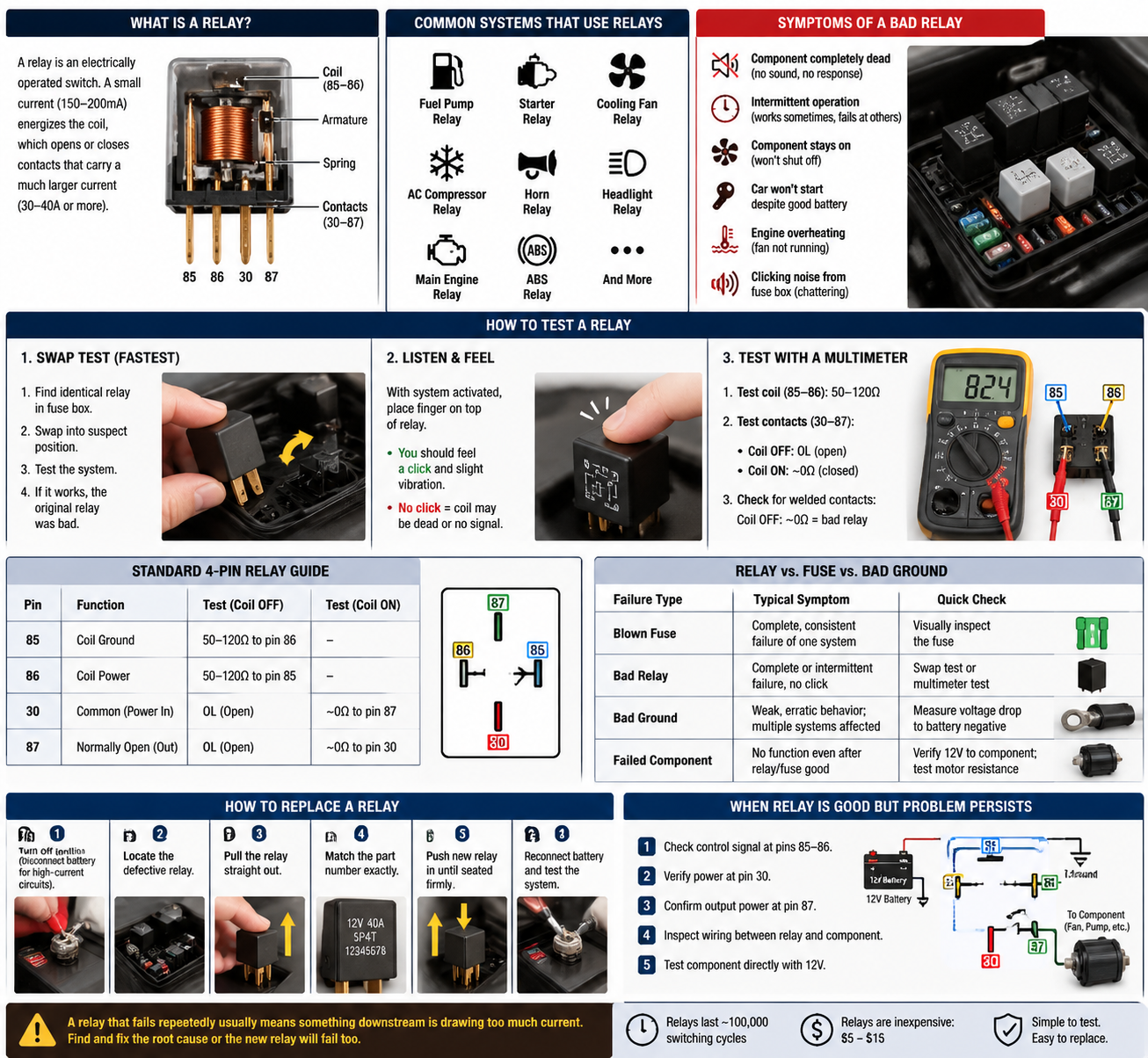
Before diagnosing a relay, it helps to understand what it does. A relay is an electrically operated switch. It uses a small control current — typically 150 to 200 milliamps — to open or close a set of contacts that carry a much larger current, sometimes 30 to 40 amps or more. This design protects sensitive control circuits (like your ECU or ignition switch) from having to handle heavy electrical loads directly.
Inside a standard automotive relay, there are four or five pins. The two control pins power an electromagnet coil. When energized, the magnet pulls a metal armature down, closing the power contacts. When the control signal is removed, a spring pushes the armature back up, opening the contacts again. This mechanical action happens thousands of times over the relay's life, and eventually the contacts burn, pit, or weld themselves shut — or the coil wire breaks internally.
Common systems in a car that rely on relays include:
- Fuel pump relay — controls power to the electric fuel pump
- Main engine relay (main relay) — supplies power to the ECU and injectors
- Starter relay — allows high current to flow to the starter motor
- Cooling fan relay — triggers the radiator or condenser fan
- AC compressor relay — engages the air conditioning clutch
- Horn relay — carries current to the horn
- Headlight relay — powers the main headlight circuit
- ABS relay — supplies the antilock brake system pump motor
Each of these can fail independently. When they do, only the system they control is affected — which is actually helpful for pinpointing the problem.
Symptoms That Point to a Bad Relay in a Car
Relay failures tend to follow recognizable patterns. Unlike a blown fuse, which cuts power cleanly and consistently, a failing relay can cause intermittent, frustrating behavior before it dies completely. Here are the most common symptom profiles:
The Component Is Completely Dead
This is the most common sign of a fully failed relay. You press the horn and hear nothing. You turn the key and the starter doesn't engage. You switch on the AC and the compressor clutch never kicks in. When a relay's contacts burn open internally, no current reaches the component it controls — full stop. The related fuse will still be intact, which is what separates this from a blown fuse diagnosis.
Intermittent Operation That Comes and Goes
A relay with pitted or corroded contacts may work sometimes and fail at other times. You might find that your fuel pump hums when the engine is cold but becomes erratic after 20 minutes of driving. Or your radiator fan works on a cool day but cuts out when the engine is hot and you need it most. Intermittent failures that worsen with heat are a classic relay warning sign, because metal contacts expand when warm and a borderline connection can open up completely under thermal stress.
The Component Stays On and Won't Shut Off
This is less common but worth knowing: if a relay's contacts weld themselves shut due to arcing or excessive current, the component stays powered even when it shouldn't be. A classic example is a cooling fan that keeps running after you've turned off the engine and walked away. Another is a fuel pump that continues to prime long after startup. A stuck-closed relay is often more damaging to the system than an open one, since it can burn out the motor it controls.
Car Won't Start Despite a Good Battery
When a car cranks fine but won't start, the fuel pump relay is one of the first suspects. If the relay isn't closing, the fuel pump never pressurizes the system, and the engine gets no fuel regardless of how good the spark is. Similarly, a failed main relay on many Honda and Acura models from the 1990s and early 2000s was infamous for causing no-start conditions, especially when the engine was warm. The car would start fine cold, then refuse to restart after a short stop.
Engine Overheating When the Fan Should Be Running
If your temperature gauge climbs abnormally at idle or in slow traffic — situations where the radiator fan should be working — but the fan isn't spinning, the cooling fan relay is a prime suspect. Before assuming the fan motor itself is dead, always check the relay. Relay replacements cost a few dollars; fan motor replacements can run $80 to $250 or more.
Clicking Noise From the Fuse Box
A relay that is chattering or rapidly clicking inside the fuse box usually means it's receiving an unstable control signal, or the coil is partially failing. You might hear a rapid clicking sound from under the hood when you try to start the car or activate a specific system. This is different from the normal single "click" a healthy relay makes when it activates. Rapid clicking usually signals a weak battery or a failing relay coil that can't hold the contacts closed.
How to Test a Relay Step by Step
There are three practical methods for testing a relay. You don't need all three — start with the swap test, and move on to multimeter testing only if you need more confirmation.
Method 1: The Swap Test (Fastest, No Tools Required)
- Open your fuse box — usually located under the hood near the battery, or under the dashboard on the driver's side. Many vehicles have both.
- Find the relay diagram on the inside of the fuse box cover or in your owner's manual. Identify the relay you suspect.
- Look for another relay nearby with the same part number or identical appearance. Relays typically have their part number printed on the side. Common numbers include 12V 30A/40A or similar specs.
- Pull out both relays. Most automotive relays unplug directly with firm finger pressure.
- Plug the known-good relay into the suspect socket.
- Test the system. If it now works, the original relay was defective. Replace it.
The only risk here is temporarily disabling the system the donor relay controlled. Don't swap your ABS relay for your horn relay during a drive. Do it with the car parked and the ignition off.
Method 2: Listen and Feel for the Click
With the relay in its socket and the relevant system activated, place your finger lightly on top of the relay. A functioning relay produces a distinct, single click and a slight physical snap as the internal armature moves. If you feel and hear this, the relay coil is working and the relay is activating. If there's nothing — no click, no vibration — the coil may be dead, or the control signal isn't reaching it. If you hear the click but the component still doesn't work, the output contacts may be burned open internally even though the coil activates.
Method 3: Test With a Multimeter
Remove the relay from the socket. Set your multimeter to resistance (Ohms) mode.
- Test the coil: On a standard 4-pin or 5-pin relay, the coil pins are typically labeled 85 and 86. Touch one probe to each. A healthy relay coil reads between 50 and 120 ohms. An open circuit reading (OL or infinite resistance) means the coil wire is broken internally and the relay is definitely bad.
- Test the normally open contacts: Pins 30 and 87 are the main power contacts on most relays. With the relay unpowered, you should read infinite resistance (open circuit) between them. Now apply 12V to the coil pins using jumper wires connected to your car battery. The multimeter should now read near zero ohms between pins 30 and 87, confirming the contacts close properly. If the resistance stays infinite after energizing the coil, the contacts are burned open.
- Test for welded contacts: Before energizing the coil, check resistance between pins 30 and 87. If you read near zero ohms with the coil unpowered, the contacts are welded shut. This relay must be replaced immediately.
| Pin Number | Function | Test (Coil Off) | Test (Coil On) |
|---|---|---|---|
| 85 | Coil ground | 50–120Ω to pin 86 | — |
| 86 | Coil power | 50–120Ω to pin 85 | — |
| 30 | Common (battery power in) | OL (open) | ~0Ω to pin 87 |
| 87 | Normally open output | OL (open) | ~0Ω to pin 30 |
How to Locate the Relay You Need to Test
One of the most common frustrations when diagnosing a relay problem is finding the right one. Modern vehicles can have anywhere from 10 to 40 relays spread across multiple fuse boxes. Here's how to locate the one you need:
- Check the fuse box cover first. Most manufacturers print a diagram on the inside of the fuse box lid showing exactly which relay or fuse controls which system. This is the fastest reference.
- Consult the owner's manual. The owner's manual usually has a dedicated section showing fuse and relay locations with labels. If you don't have a physical copy, most manufacturers offer free PDF downloads on their official websites.
- Use a factory service manual or wiring diagram. For older or less common vehicles, a factory service manual (available from dealers or as a PDF from sites like AllDataDIY or Mitchell1) provides complete relay locations, wiring diagrams, and testing procedures specific to your exact model and year.
- Look in both fuse boxes. Many cars have one box under the hood and one inside the cabin. The under-hood box typically handles high-current systems like the fuel pump, cooling fans, and starter. The interior box usually covers lighting, wipers, and accessories.
- Search your model year on forums. For common relay failures like the Honda main relay or the Ford fuel pump relay, enthusiast forums often have pinned threads with exact location photos and step-by-step testing procedures tailored to your specific vehicle.
Relay vs. Fuse vs. Bad Ground: How to Tell the Difference
Because the symptoms of a failed relay can overlap with a blown fuse or a corroded ground connection, it's worth knowing how to separate them before you start replacing parts.
| Failure Type | Typical Symptom | Quick Check |
|---|---|---|
| Blown fuse | Complete, consistent failure of one system | Visually inspect the fuse — broken wire inside |
| Bad relay | Complete or intermittent failure, no click felt | Swap test or multimeter coil/contact test |
| Bad ground | Weak, erratic behavior; multiple systems affected | Measure voltage drop from component chassis to battery negative |
| Failed component | No function even after relay/fuse confirmed good | Verify 12V reaches component; test motor resistance |
A blown fuse is the easiest to rule out — pull it and look at it. If the thin metal strip inside is visibly broken or melted, replace it. If the fuse looks fine but the system is still dead, move on to the relay. If the relay tests good, the problem is either in the wiring or the component itself.
A bad ground usually affects multiple systems simultaneously or causes strange symptoms like dash lights flickering when you use the horn, or the radio cutting out when the windows are rolled down. A relay failure, by contrast, tends to be isolated to the specific circuit it controls.
How to Replace a Car Relay
Replacing a relay is one of the simplest car repairs you can do. In almost every case, no tools are required.
- Turn off the ignition and, for high-current relays like the fuel pump or starter relay, disconnect the negative battery terminal as a safety measure.
- Locate the defective relay using the fuse box diagram or owner's manual.
- Grip the relay firmly and pull it straight out of its socket. Some relays have a small tab or clip that needs to be depressed first.
- Note the part number on the side of the old relay. Match it exactly when purchasing the replacement. Auto parts stores like AutoZone, O'Reilly, and Advance Auto typically carry standard automotive relays for $5 to $15. Dealer-specific relays may cost more.
- Push the new relay into the socket until it seats firmly. It should only fit one way — the pin arrangement prevents incorrect installation on most relay types.
- Reconnect the battery if you disconnected it, then test the system.
If a relay fails repeatedly or blows quickly after replacement, do not just keep replacing it. A relay that keeps failing is telling you that something downstream is drawing too much current — possibly a short circuit in the wiring or a failing motor that's pulling excessive amperage. Continuing to replace the relay without finding the root cause can damage wiring harnesses or start a fire.
Relay Problems Specific to Certain Cars and Systems
Some vehicles have well-documented relay failure patterns that are worth knowing about:
Honda and Acura Main Relay
This is arguably the most famous relay failure in automotive history. The PGM-FI main relay on 1990s Honda Civics, Accords, and Acura Integras was prone to cracking solder joints on the circuit board inside the relay housing. The cracked joints would open up when the relay got hot, causing the engine to cut out or refuse to restart after a warm soak. The fix — either replacing the relay or resoldering the board — became a standard repair for anyone owning these vehicles.
Ford Fuel Pump Relay
Ford trucks and Mustangs from the late 1980s through the 2000s frequently developed fuel pump relay failures. The relay sits in the engine compartment fuse box and is subject to heat cycles. Symptoms were classic: the engine would crank but not start, with no audible fuel pump prime hum when the key was turned to the "on" position. The relay was often the fix before replacing the fuel pump itself.
General Motors Cooling Fan Relay
Many GM vehicles from the 1990s and 2000s — particularly front-wheel-drive models like the Cavalier, Sunfire, and various Buick and Oldsmobile models — had cooling fan relay failures that led to overheating. The relay was located in the underhood fuse center and was relatively inexpensive to replace, but the failure was often misdiagnosed as a bad fan motor or coolant temperature sensor.
Jeep and Chrysler ASD Relay
The Auto Shutdown (ASD) relay on many Jeep Wranglers, Cherokees, and Chrysler vehicles controls power to the fuel injectors and ignition coil. When this relay fails, the engine cranks but won't fire because neither the injectors nor the coil receive power. This relay is located in the Power Distribution Center (PDC) under the hood and is a frequent first check on a no-start Jeep.
When the Relay Tests Fine but the Problem Persists
If you've tested the relay and it passes, or you've replaced it and the problem didn't go away, the fault lies elsewhere in the circuit. Here's a logical path forward:
- Check whether the relay is receiving a control signal. With a test light or voltmeter, check pins 85 and 86 while activating the system. One pin should show battery voltage; the other should go to ground. If neither changes when you turn on the system, the issue is in the control circuit — the switch, the ECU, or the wiring feeding the relay coil.
- Check whether power is reaching the relay input. Pin 30 should have battery voltage present at all times (on most circuits). If there's no voltage here, trace back toward the fuse or fusible link supplying this circuit.
- Check whether the output side is delivering power. With the relay activated, pin 87 should show battery voltage. If the relay clicks and the multimeter confirms the contacts are closing, but pin 87 still shows no voltage, the relay socket itself may have a corroded or broken terminal.
- Inspect the wiring between the relay and the component. Rodent damage, chafed insulation, and corroded connectors between the relay and the motor or solenoid it controls are common causes of failure after the relay has been confirmed good.
- Test the component directly. Apply 12V directly to the fuel pump, fan motor, or other component using jumper wires from the battery. If it works, the component itself is fine and the fault is in the circuit feeding it. If it doesn't work, the component has failed independently of the relay.
How Long Do Car Relays Last and What Causes Them to Fail
A quality automotive relay is rated for approximately 100,000 switching cycles under rated load. For a relay that activates once every engine start, that's theoretically over 100,000 starts — more than most cars will ever see. In practice, relays fail for reasons other than simple wear:
- Overloading: When a relay is asked to carry more current than it's rated for — due to a failing motor drawing excess amperage — the contacts arc and burn out prematurely. This is why a relay that fails repeatedly usually signals a downstream problem.
- Heat exposure: Relays mounted in hot engine compartments degrade faster than those in cooler locations. The solder joints, coil insulation, and contact surfaces all suffer under repeated thermal stress.
- Moisture and corrosion: Relays in exposed locations can absorb moisture, leading to corrosion of the contacts or the pins in the socket. This often causes intermittent rather than hard failures.
- Vibration: On high-mileage vehicles, constant engine and road vibration can fatigue the internal connections and contacts, particularly in relays that were never designed with vibration dampening.
- Manufacturing defects: Solder joint failures like those seen in the Honda main relay were factory defects that showed up after enough heat cycles had passed — not failures caused by wear or misuse.
There is no standard maintenance schedule for relay replacement — they are considered fail-as-needed parts. However, on vehicles known for specific relay problems, proactive replacement before a failure strands you is a reasonable and inexpensive precaution.




 Add :Gulin Industrial Zone, Gulin, Haishu District, Ningbo, Zhejiang, China
 Tel :+86-574-88124152
 Fax :+86-574-88044539
 Mob/WhatsApp :+86-13858360959
 E-mail :