

 English
 中文简体
中文简体 Español
The Most Commonly Used Relay: A Direct Answer
The electromagnetic relay (EMR) — specifically the general-purpose plug-in relay — is the most widely used relay type across residential, commercial, and industrial applications worldwide. Within that category, the SPDT (Single Pole Double Throw) and DPDT (Double Pole Double Throw) electromagnetic relays claim the highest usage volumes. They appear in everything from household appliances and HVAC systems to factory automation panels and automotive electronics.
If you narrow the field to purely electronic and PCB-level circuits, then the solid-state relay (SSR) has surged dramatically in popularity since the early 2000s, particularly for high-frequency switching and environments where mechanical wear is unacceptable. But in raw unit shipment numbers across all sectors, the traditional electromagnetic relay still leads by a considerable margin.
According to industry market data from Allied Market Research, the global relay market was valued at approximately $12.4 billion in 2022 and is projected to reach $18.1 billion by 2031. Electromagnetic relays account for roughly 55–60% of total relay shipments, confirming their dominant position across the market.
Understanding What a Relay Actually Does
A relay is an electrically operated switch. When an input signal (usually a low-power electrical current) energizes a coil or semiconductor element inside the relay, it triggers the opening or closing of one or more separate electrical circuits. This allows a low-voltage control system — a microcontroller, a PLC output, or a simple pushbutton — to switch high-voltage or high-current loads without direct electrical connection between the two circuits.
The fundamental value of a relay lies in two things: electrical isolation and signal amplification. A 5V logic output from an Arduino can, through a relay, control a 240V AC motor. A tiny thermostat signal can switch a 30-amp HVAC compressor circuit. That combination of isolation and control versatility is why relays have remained indispensable for over a century.
Core Parts of an Electromagnetic Relay
- Coil: Wound around an iron core; when energized, it creates a magnetic field.
- Armature: A movable iron piece attracted by the magnetic field.
- Contacts: The switching elements — normally open (NO), normally closed (NC), or common (COM).
- Spring: Returns the armature to its original position when the coil is de-energized.
- Yoke and Frame: Provides the magnetic path and mechanical housing.
The Main Types of Relays and Where Each Is Used
Relay technology has diversified significantly over the decades. Each relay type has specific strengths that make it the preferred choice for particular applications. Understanding these distinctions helps explain why certain relay families dominate specific industries.
Electromagnetic Relays (EMR)
The electromagnetic relay is the original and most fundamental relay design. It uses a coil of wire wound around a ferromagnetic core. When current passes through the coil, the magnetic field physically moves a set of contacts. EMRs handle both AC and DC loads, are extremely robust, and are available in virtually every contact configuration.
Common coil voltages include 5V DC, 12V DC, 24V DC, and 24V AC. Contact ratings commonly run from 5A to 30A at 250V AC. They are ubiquitous in control panels, automation cabinets, home appliances, and automotive applications.
Solid-State Relays (SSR)
The solid-state relay replaced mechanical contacts with semiconductor switching elements — typically TRIACs, SCRs, or MOSFETs. There are no moving parts, which means SSRs switch silently, produce no contact arcing, and have essentially unlimited electrical switching life. They excel in applications requiring fast, frequent switching or where electromagnetic interference from arcing contacts would be problematic.
SSRs are heavily used in temperature controllers, medical equipment, semiconductor manufacturing, and food processing machinery. Their main drawback is a voltage drop across the output (typically 1–1.5V), which generates heat and requires heat sinking for higher current loads.
Reed Relays
A reed relay uses a pair of ferromagnetic reeds sealed inside a glass capsule filled with inert gas. The reeds snap together when a magnetic field is applied. Reed relays switch extremely fast — operate times as low as 0.5 milliseconds — and handle low-level signals cleanly, making them popular in telecommunications switching, medical instrumentation, and automated test equipment (ATE).
Thermal Relays (Overload Relays)
Thermal relays — more accurately called thermal overload relays — protect motors from overheating due to sustained overcurrent. They contain bimetallic strips that bend when heated by excess current, tripping the relay contacts. They are a standard component in every motor starter assembly in industrial applications, protecting pumps, conveyors, compressors, and fans.
Latching Relays
A latching relay maintains its switched state without continuous coil power. Once set by a pulse, it stays in position until a reset pulse is applied. This makes latching relays ideal for energy-saving applications, smart meters, and lighting control systems where holding coil power continuously would be wasteful.
High-Voltage and Power Relays
These relays are built for switching loads at high voltage (above 400V) or high current (above 50A). They are found in electric vehicle battery management systems, solar inverters, and industrial power distribution panels. EV battery systems in particular have driven rapid growth in this relay segment since 2015.
Relay Type Comparison: Electromagnetic vs Solid-State
The choice between electromagnetic and solid-state relays is the most common decision engineers face. The table below summarizes key performance differences:
| Parameter | Electromagnetic Relay | Solid-State Relay |
|---|---|---|
| Switching Speed | 5–15 ms | <1 ms |
| Mechanical Life | 10–100 million operations | Unlimited (no moving parts) |
| Contact Resistance | Very low (~50 mΩ) | Higher (1–1.5V drop) |
| Noise / EMI | Audible click; arc EMI | Silent; minimal EMI |
| Heat Generation | Low (minimal on-state loss) | Higher (requires heat sink at >10A) |
| Cost | Low ($0.50–$5 typical) | Higher ($3–$30+ typical) |
| Load Types | AC and DC | Usually AC or DC (type-specific) |
| Isolation | Excellent (air gap) | Good (optical isolation typical) |
Which Relay Is Most Used in Industrial Automation
In industrial automation — arguably the single largest relay application sector — the 24V DC general-purpose plug-in relay is overwhelmingly the most common choice. Control cabinets for PLCs, conveyor systems, packaging lines, and process control panels are typically built around relay modules operating at 24V DC, matching the standard PLC output voltage.
Brands like Phoenix Contact, Finder, Omron, Weidmuller, and Schneider Electric supply enormous quantities of 24V DC plug-in relays to automation panel builders every year. A moderately sized automation cabinet might contain anywhere from 20 to 200 individual relay sockets, each populated with a plug-in electromagnetic relay.
The contactor — a heavy-duty electromagnetic switching device closely related to the relay — is the most-used device for motor starting and power switching in industrial settings. While technically a contactor rather than a control relay, it operates on the same electromagnetic principle and is the relay family's highest-power member.
Interface Relays and Terminal-Block Relays
A specialized subtype that has become extremely prevalent in modern automation is the interface relay — a slim-profile plug-in relay mounted on a DIN rail socket, designed to interface between PLC outputs and field devices. Products like the Finder Series 34, Phoenix Contact PLC-RSC, and Omron G2RV are used in enormous quantities in panel-building worldwide.
These relays typically have 6mm to 8mm body widths, allowing dozens of channels to fit in a compact control cabinet. Their coil voltage is almost always 24V DC, matching PLC digital output cards directly. Contact ratings run from 6A to 16A at 250V AC, sufficient for the vast majority of industrial load switching tasks.
Which Relay Is Most Used in Automotive Applications
The automotive sector uses a specific, standardized form factor known as the ISO mini relay (also called the Bosch-style or standard automotive relay) more than any other type. This relay follows an internationally recognized footprint with a 5-pin or 4-pin configuration and fits into standard relay sockets found in automotive fuse and relay boxes.
The standard automotive relay operates on 12V DC (or 24V DC for trucks and heavy vehicles) with contact ratings of 30A or 40A. They control headlights, horns, cooling fans, fuel pumps, starter circuits, AC compressor clutches, and dozens of other vehicle loads. A typical passenger vehicle contains between 15 and 40 relays, depending on feature content.
Major automotive relay suppliers include TE Connectivity (Tyco), Omron, Panasonic, Hella, and Bosch. Global automotive relay production runs into the billions of units per year, making this one of the highest-volume relay applications in existence.
EV and Hybrid Vehicle Relays
Electric and hybrid vehicles have introduced a new, fast-growing relay category: the high-voltage battery disconnect relay. These relays must handle 400V DC or 800V DC at currents up to 500A during fast charging. They require sealed contacts, arc suppression, and often a precharge relay to protect the main contacts from inrush current. This segment is growing at over 25% annually as EV adoption accelerates globally.
Which Relay Is Most Used in Home Appliances and HVAC
In household appliances — washing machines, dishwashers, microwave ovens, refrigerators, and air conditioners — the PCB-mount electromagnetic relay is the overwhelmingly dominant choice. These relays are soldered directly onto control boards and switch compressor motors, heating elements, water valves, and fan motors.
The Omron G5LE, Panasonic AL series, and similar compact PCB relays are among the highest-unit-volume relays ever manufactured. They operate at 5V DC, 12V DC, or 24V DC coil voltages and switch AC loads up to 10A or 16A at 250V AC. A single model — the Omron G5LE-1 — has been produced in quantities exceeding hundreds of millions of units across its production life.
HVAC systems use relays extensively for controlling compressor contactors, fan motors, electric heat strips, reversing valves, and auxiliary equipment. The ice cube relay (a general-purpose 8-pin or 11-pin octal relay in a plug-in socket) is a fixture of HVAC control panels and has been for decades. Brands like Magnecraft, Dayton, and Schneider Electric supply these relays in large quantities to the HVAC and building controls industries.
Relay Contact Configurations Explained
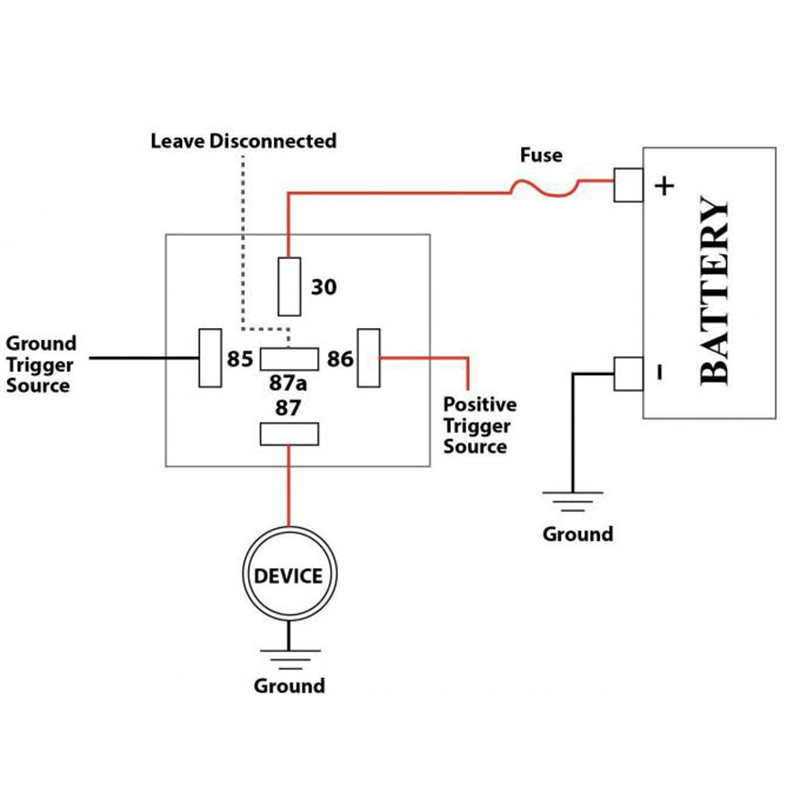
Understanding contact configuration is essential to selecting the right relay. The contact arrangement determines how the relay can be wired and what switching logic it can perform.
- SPST-NO (Single Pole Single Throw, Normally Open): The simplest relay. One circuit, open at rest, closes when energized. Used for simple on/off control — turning a light or pump on.
- SPST-NC (Single Pole Single Throw, Normally Closed): One circuit, closed at rest, opens when energized. Used for fail-safe circuits — if power fails, the circuit remains closed.
- SPDT (Single Pole Double Throw): One common contact switches between NO and NC positions. Extremely versatile — allows routing a circuit between two paths. The most commonly specified general-purpose relay contact form.
- DPDT (Double Pole Double Throw): Two independent SPDT switches operated by one coil. Useful when two separate circuits must switch simultaneously — very common in control panels and appliances.
- 4PDT (Four Pole Double Throw): Four SPDT switches operated by one coil. Used in applications needing simultaneous switching of multiple circuits, such as motor reversing or complex signal routing.
The SPDT configuration is statistically the most specified contact form across all relay families, because its combination of NO, NC, and COM contacts provides maximum circuit flexibility in a single device.
Key Relay Specifications You Must Understand
Selecting the correct relay requires understanding a set of electrical and mechanical specifications. Getting these wrong results in premature relay failure, overheating, contact welding, or nuisance tripping.
Coil Voltage and Pickup/Dropout Voltage
The coil voltage is the nominal voltage at which the relay is designed to operate. The pickup voltage is the minimum voltage at which the relay will reliably energize — typically 75–80% of nominal coil voltage. The dropout voltage is the maximum voltage at which the relay will de-energize — typically 10–20% of nominal. This means a 24V DC relay will generally energize at approximately 18–19V and release at 2–5V.
Contact Rating
Contact rating specifies the maximum current and voltage the relay contacts can safely switch. Ratings are typically given for both resistive and inductive loads, since inductive loads (motors, solenoids, transformers) generate voltage spikes that stress contacts more severely. An electromagnetic relay rated at 10A resistive may only be rated at 3–4A inductive. Always derate contacts by 20–30% for long service life in demanding applications.
Electrical and Mechanical Life
Mechanical life refers to the number of operations the relay can perform without load on the contacts. Electrical life is the number of on/off cycles under rated load conditions. For a typical general-purpose electromagnetic relay:
- Mechanical life: 10 million to 100 million operations
- Electrical life at rated load: 100,000 to 500,000 operations
- Electrical life at 10% of rated load: 1 million to 10 million operations
This is why contact derating and suppression of inductive spikes (using flyback diodes for DC loads, RC snubbers for AC) is so important for achieving long service life.
Operate and Release Time
For most general-purpose electromagnetic relays, the operate time (coil energized to contacts closed) runs between 5 and 15 milliseconds. Release time (coil de-energized to contacts open) runs from 2 to 10 milliseconds. For time-critical applications — safety circuits, interlock logic, high-speed process control — these timing parameters must be carefully evaluated.
Most Used Relay Brands and Product Families Worldwide
Several manufacturers dominate the global relay market across different segments. Here is a practical overview of the most widely used relay families by brand:
| Brand | Most Used Model/Series | Primary Application |
|---|---|---|
| Omron | G5LE, G2R, G5Q | PCB mount, appliances, automation |
| Finder | Series 40, 55, 60, 34 | Industrial control, DIN rail panels |
| TE Connectivity | OJT, V23234, PCJ | Automotive, telecom, industrial |
| Panasonic | AL, TQ, JW series | PCB mount, appliances, automotive |
| Phoenix Contact | PLC-RSC, REL-MR | PLC interface, automation cabinets |
| Schneider Electric | Zelio RXM, RSB | Industrial, HVAC, building control |
| Crydom / Sensata | HD, DR, CWA series SSR | Solid-state relays, process control |
How to Choose the Right Relay for Your Application
Selecting the correct relay is not complicated when approached systematically. Work through these parameters in order:
- Define the load: What voltage and current will the relay contacts switch? Is the load resistive (heating elements, lamps) or inductive (motors, solenoids)?
- Determine coil voltage: What control voltage is available — 5V, 12V, 24V DC, 120V AC, 240V AC?
- Choose the contact configuration: Do you need NO, NC, SPDT, or DPDT switching logic?
- Consider switching frequency: Low frequency (less than a few cycles per minute) favors EMR; high frequency favors SSR.
- Evaluate the environment: Will the relay face vibration, moisture, extreme temperature, or corrosive atmospheres? These factors may require sealed or hermetic relay types.
- Assess space and mounting: Does the relay need to be PCB-mounted, DIN rail mounted, or chassis mounted? Is panel space at a premium?
- Review life requirements: What is the required service life in operations? Does the application require predictive maintenance scheduling?
When to Use a Suppression Circuit
Any relay switching an inductive load should have suppression applied across the load or the coil. For DC loads, a flyback diode (freewheeling diode) placed across the coil in reverse polarity eliminates the back-EMF spike. For AC loads, an RC snubber circuit (typically 100Ω in series with 0.1µF across the contacts) suppresses contact arcing. Without suppression, contact erosion is accelerated and the relay life can drop to 10–20% of rated electrical life.
Relay Failure Modes and How to Avoid Them
Understanding why relays fail is essential for designing reliable systems. The most common relay failure modes are:
- Contact welding: Occurs when contacts close under high inrush current (motor starting, capacitive loads) and fuse together. Prevention: select a relay with adequate inrush current rating or use a current-limiting circuit.
- Contact erosion: Gradual material loss due to arcing on every switching cycle. Prevention: apply load suppression, derate contacts, and select silver alloy contacts for inductive loads.
- Coil failure: Open or shorted coil winding, often caused by overvoltage, excessive temperature, or moisture. Prevention: ensure coil voltage stays within rated range; use relays with rated insulation class for the operating temperature.
- Mechanical failure: Spring fatigue or armature sticking, especially in high-cycle applications. Prevention: schedule replacement based on operation count when using maintenance tracking systems.
- Insulation breakdown: Loss of isolation between coil and contacts, often caused by contamination or voltage transients. Prevention: use sealed relay types in harsh environments; install transient voltage suppressors in the circuit.
Emerging Trends in Relay Technology
The relay industry is not standing still. Several technology and market trends are reshaping which relay types will dominate in the coming decade.
Smart Relays and Intelligent Relay Modules
Modern relay modules increasingly incorporate operation counters, coil voltage monitoring, and predictive maintenance indicators. Products like the Finder SMART relay range and Phoenix Contact Smart Relay modules provide diagnostic data over IO-Link or other industrial communication protocols, allowing maintenance systems to track relay wear and schedule replacements before failure occurs.
High-Voltage DC Relays for Energy Transition
The growth of solar energy systems, battery storage, and electric vehicles is driving massive demand for relays capable of switching high-voltage DC (HVDC). DC switching is inherently more challenging than AC switching because DC arcs do not self-extinguish at current zero crossings the way AC arcs do. Specialist relay designs using magnetic arc blowout and sealed gas-filled chambers are required. This is among the fastest-growing segments in the entire relay market, with compound annual growth rates exceeding 20% in several product subcategories.
Miniaturization and Ultra-Compact Form Factors
Consumer electronics and medical devices continue pushing relay footprints smaller. Signal relays with 2.5mm x 2.0mm SMD footprints switching milliamp-level signals are now commonplace in portable medical devices and wireless communication equipment. These ultra-compact relays maintain the core relay value proposition — electrical isolation — in the smallest possible package.
MEMS Relays
Micro-electromechanical system (MEMS) relays are fabricated using semiconductor manufacturing processes, resulting in relay elements that are thousands of times smaller than conventional relays. They switch in microseconds, handle low-level signals with extremely low contact resistance, and are immune to magnetic fields. While currently limited to low-voltage, low-current applications, MEMS relays are gaining traction in instrumentation, telecommunications, and aerospace applications where size and switching speed are paramount.
Summary: Which Relay Should You Use
If the question is purely about which relay type appears in more applications and higher unit volumes than any other, the answer remains clear: the general-purpose electromagnetic relay in SPDT or DPDT configuration, operating at 12V DC or 24V DC, is the most used relay in the world today. It is affordable, well-understood, available from dozens of manufacturers in countless variants, and suitable for the majority of switching tasks encountered in everyday electrical and industrial applications.
However, "most used" does not mean "best for every situation." The right relay depends entirely on the specific application requirements. For high-frequency switching, go solid-state. For automotive standardization, use the ISO mini relay. For precision low-signal switching, specify a reed relay. For motor protection, install a thermal overload relay. For energy savings in remote switching, a latching relay pays dividends over time.
What has not changed across a century of relay use is the fundamental reason they exist: safe, reliable electrical isolation between a control signal and a switched load. As long as that requirement exists — and it will for the foreseeable future — the relay will remain a cornerstone component in electrical engineering worldwide.


 Add :Gulin Industrial Zone, Gulin, Haishu District, Ningbo, Zhejiang, China
 Tel :+86-574-88124152
 Fax :+86-574-88044539
 Mob/WhatsApp :+86-13858360959
 E-mail :